
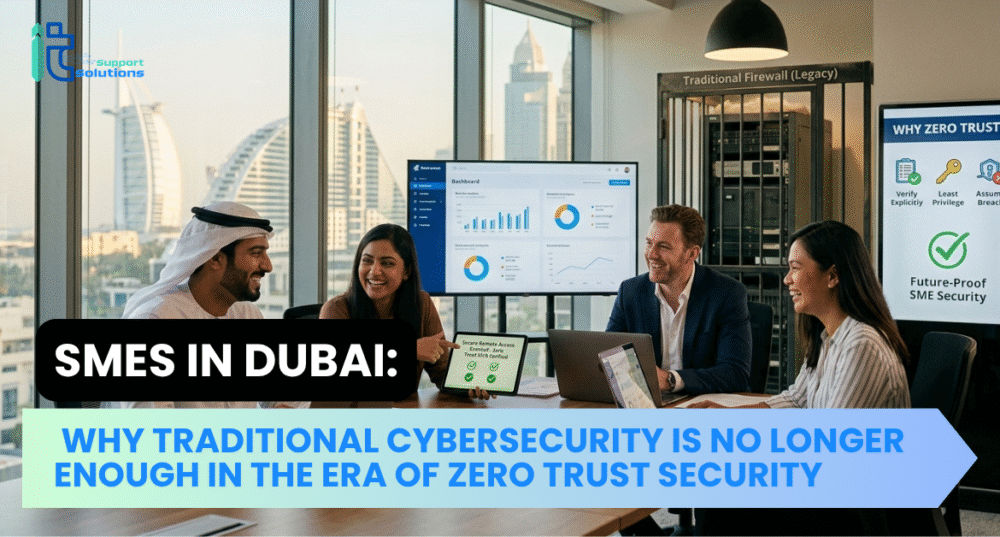
Ransomware attacks are now appearing more frequently among small and medium-sized businesses in Dubai. Constant shifts mark the landscape of cyber dangers, their frequency rising steadily, and phishing activities follow a similar upward path, catching attention through frequency alone.
Smaller organisations now face growing cyber threats once aimed mainly at large corporations. Insider risks and unauthorized access are increasing quietly as attackers shift focus toward less-protected businesses. In today’s digital era and expanding remote work environments, SMEs face significant cybersecurity challenges.
The traditional approach of security systems was based on the premise that everything within a company’s network was trustworthy. After someone was added to the network, its access was frequently not controlled. But times have changed and new cyber-attacks have made it evident that this is not a fool proof method.
That’s where Zero Trust Security Solution is looking to reshape the future of cybersecurity in the UAE for businesses. Zero Trust is as simple as the principle is to “never trust, always verify.” Access to any user, device, application or connection should be continually authenticated before they can access the information.
Why the Shift to New Security Models from the Traditional?
Businesses used perimeter-based security – like firewalls and antivirus – to secure their networks for years. These tools, however, are still relevant and needed but not alone.
The workplace has undergone huge transformation:
- Employees work remotely
- A broad spectrum of cloud apps is being utilized
- Mobile devices are utilized from different sites
- Business data is continually flowing between platforms
- Cyberattacks are now more sophisticated
A typical security model would presume that people within the network are secure. But with today’s attacks, which utilize stolen credentials, phishing e-mails or hacked devices, it is possible to circumvent these protections. Once inside they are able to easily move throughout systems and gain access to sensitive information.
This new level of vulnerability has driven the growth of Zero Trust architecture as a new approach.
So, What Is Zero Trust Security?
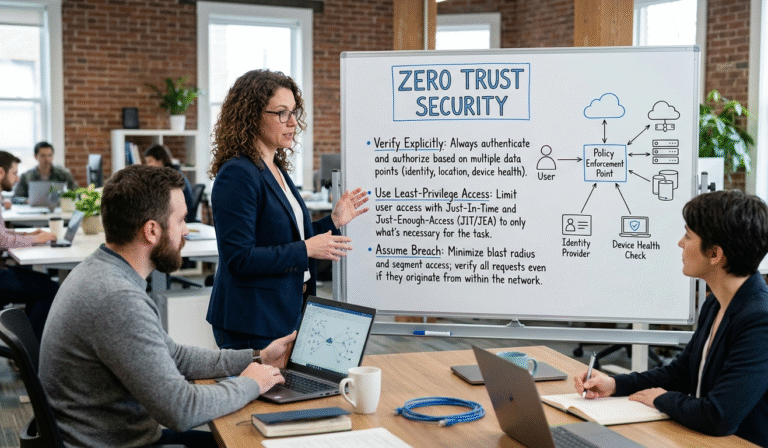
Zero Trust is not a product or software product. It’s a cybersecurity system that aims to remove the implicit trust in IT environments.
In a Zero Trust approach:
- All accesses are checked
- An access level is assigned to users that does not exceed a certain limit
- The devices’ security must comply with needs
- Activities are monitored on an ongoing basis
- Security responses are initiated if there is any suspicious behavior
The aim is to minimize the risk of any unauthorized access and damage that may ensue.
Zero Trust is based upon three fundamental principles: verify explicitly, use least-privilege access, assume that any breach is possible.
The Importance of Zero Trust for Dubai SMEs
Digitalization, cloud services and hybrid working are becoming the new trends in Dubai businesses. Although this change is more efficient, it also exposes businesses to cyber threats.
SMEs will feel that they may be too small to be targets. In fact, smaller businesses have been a common target for attackers as they often have less robust security measures than larger businesses.
Zero Trust has the potential to enhance security for SMEs by providing:
- Limiting unauthorized access
- Security of valuable company information
- Reducing insider threats
- Keeping workplaces safe and secure from afar
- Improving compliance readiness
- Improving visibility on networks
In the era of cloud technologies and remote working, Zero Trust creates a more robust security base for the business’ future.
How Firewalls Strengthen Zero Trust Security
Firewalls are still a crucial component in today’s cybersecurity approach. But, when they are combined with a Zero Trust solution, they become more effective.
To help safeguard yourself, modern firewalls are able to handle:
- Application-level filtering
- User identity verification
- Traffic inspection
- Threat intelligence integration
- Intrusion prevention systems
Unlike other firewalls, Zero Trust firewalls do not stop traffic from outside the network, rather they examine every connection attempt, from anywhere.
This is a multi-layered approach which can help businesses mitigate the risks posed by unauthorized access and lateral movement in their networks.
Endpoint Protection Has Become Critical to the Business
Each device that is connected is a potential hacker’s access point. Hazardous devices can be laptops, smartphones, tablets or remote desktops if not properly protected.
By taking a Zero Trust approach to security, you strengthen endpoint security by:
- Regularly testing the condition of the device, checking for damage or issues
- Enforcing security policies
- Restricting device access
- Detecting unusual behavior
- Real-time monitoring of users’ activity
When combined with Zero Trust policies, endpoint protection tools can help guarantee secure and authorized devices have access to company resources.
This is particularly important for companies with remote workers or more than one office.
How Antivirus Solutions Fit into Zero Trust Defense
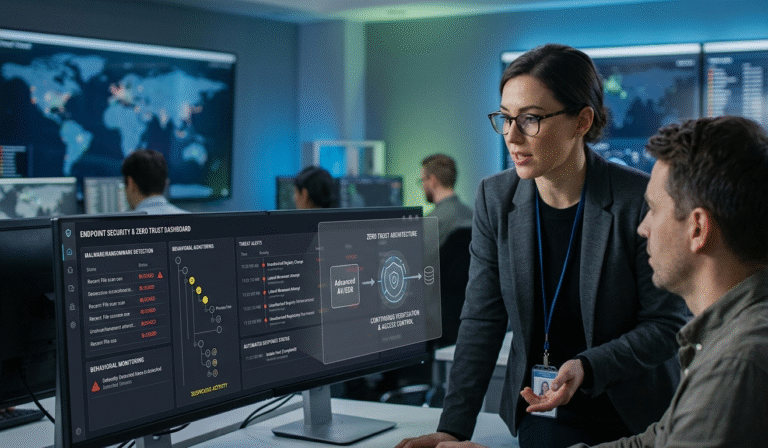
Older antivirus products are not enough to ward off today’s new cyber threats. But still, advanced antivirus and Endpoint Detection systems are essential parts of a Zero Trust strategy.
Current antivirus solutions aid companies in the following ways:
- Detecting malware and ransomware
- Blocking malicious files
- Monitoring suspicious behavior
- Issuing alerts of threats as they happen
- Providing assistance for automated reactions to threats
With ongoing and regular verification, combined with access control, antivirus software can be even more effective at averting breaches.
Why Is Network Segmentation Important?
Network segmentation is one of the best aspects of Zero Trust. Rather than letting everyone in on the network, businesses partition the network into smaller, more secure areas.
This means:
- HR systems are still standalone
- Finances remain secure
- Sensitive applications require extra authentication
- Network attackers are unable to roam around networks
If a segment of the network is attacked, segmentation will limit the damage and also help to contain the attack.
The Use of Constant Monitoring and Threat Detection
Cybersecurity has no longer become a “set and forget” process. Businesses need to be constantly vigilant and aware of any suspicious activities so that they can prevent them from turning into a serious incident.
In the case of a Zero Trust environment, the following are used:
- Real-time monitoring
- AI-powered threat detection
- Behavioral analytics
- Automated security alerts
- Continuous authentication checks
By taking proactive measures, businesses can be more responsive to potential threats, reduce downtime and disruption and have the time to respond.
How SMEs Can Prepare for the Future of Cybersecurity
With the increasing digitisation of businesses, cyber threats will keep on evolving. It is no longer sufficient for SMEs in Dubai to only depend on traditional methods of security.
Zero Trust security provides a more intelligent and flexible solution that incorporates a combination of:
- Firewalls
- Endpoint protection
- Antivirus systems
- Identity verification
- Network segmentation
- Continuous monitoring
Combined, these technologies provide a heightened protection level against today’s cyber threats.
Zero Trust is no longer a strategy that applies to the enterprise alone – it’s a business imperative for a company that wants to enhance its security efforts. It has emerged as a viable and necessary approach to security for small to medium-sized enterprises looking to stay secure, continue to operate and remain protected in the long-term digital environment.
With advanced cybersecurity solutions from ITSS, businesses can implement stronger Zero Trust frameworks that help secure users, devices, applications, and networks against evolving cyber risks. From firewall management and endpoint protection to continuous monitoring and access control, ITSS supports organizations with reliable security solutions designed to improve resilience, reduce vulnerabilities, and maintain uninterrupted business operations in an increasingly connected world.

