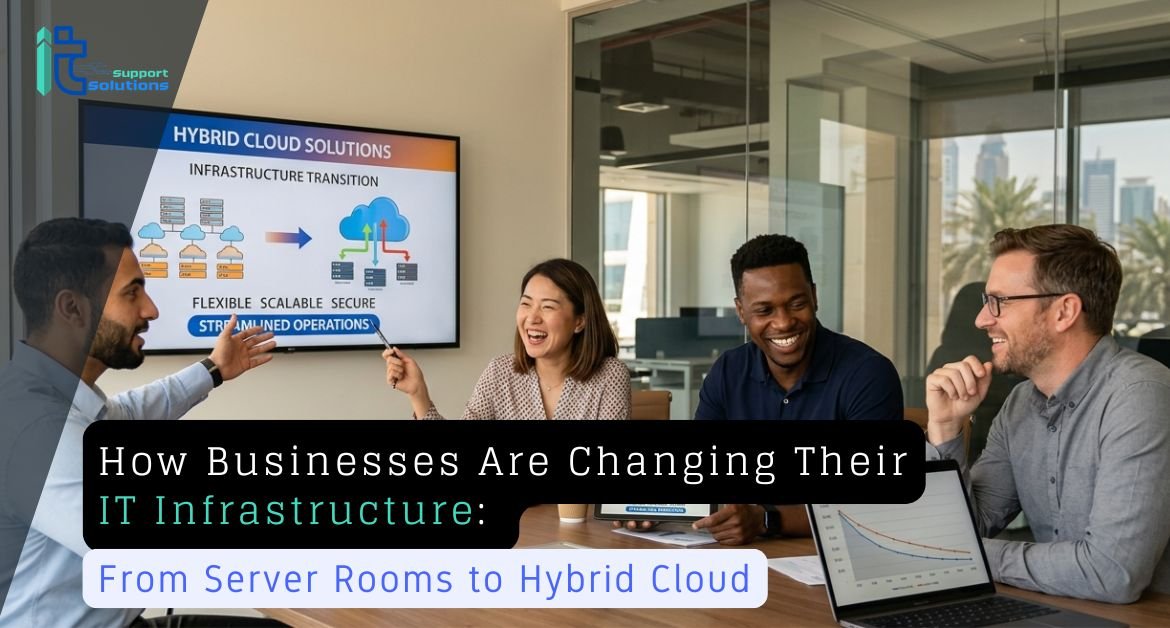
Business technology management has completely evolved in the past couple of years. In the past, every organization had a server room where they had to keep important applications, storage and networking devices in office premises. These systems provided control, but had high maintenance, cooling, hardware upgrade, security, and IT management costs.
Organizations are evolving to a more flexible and scalable model – the Hybrid Cloud – today. This method brings the benefits of both on-premises and cloud-based infrastructure—reliability and scalability. The UAE-based firms are turning to hybrid environments to streamline their operations, boost cybersecurity measures, cut costs, and future-proof their operations.
In Today's Digital Era, the Days of Traditional Server Rooms Are Over
These days, it’s no longer enough to have a traditional server room.
For several years, enterprises completely relied on in-house servers in their offices or data centres. While this configuration was successful in the past, it has been identified that there are some drawbacks with this configuration in today’s business requirements:
- Causes of high infrastructure and maintenance costs
- Growth is limited and hence there is a constraint of scaling
- Increased downtime risks
- Long and complicated disaster recovery operations
- Growing cybersecurity challenges
- Struggle with supporting remote and hybrid workforces
With the ever-increasing amount of data produced by businesses, and digital operations increasingly essential to them, traditional infrastructure is sometimes unable to cope. The systems that organizations need today must be able to scale up and down rapidly, be secured for remote access, and be highly available.
This change has contributed to the transition towards cloud-based infrastructure solutions.
Understanding Hybrid Cloud Infrastructure Is Vital
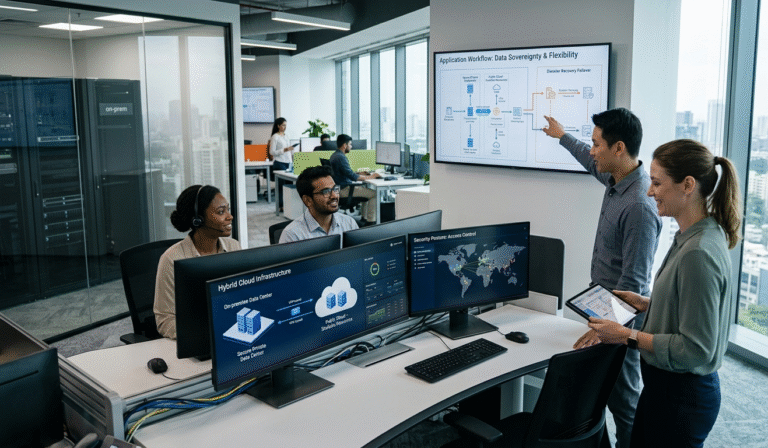
Hybrid cloud is a solution where the private infrastructure is connected with public cloud. Businesses don’t replace their existing systems; they just add cloud to their existing servers and applications.
With this configuration, organizations can:
- Keep sensitive workloads on private infrastructure, rather than on public cloud
- Try to use public cloud resources to scale, as advised
- Keep business up and running in distress scenarios
- Improve workload flexibility
- Securely send and receive access applications from anywhere
- Optimize operational expenses
The hybrid cloud option helps businesses gain a firmer grip while enjoying cloud agility. The equilibrium has become a vital aspect for organizations that want to transform into digital without affecting the current operations.
Hybrid Cloud Is Reshaping Businesses Across the UAE
UAE businesses are on a quick path of modernization to incorporate innovation, automation, and remote access into their IT landscape. The finance and health care sectors, logistics, retail and education are increasingly reliant on the stability and dependability of digital infrastructure in order to compete.
Adopting the hybrid cloud is becoming the trend because it enables businesses:
- Face the changing compliance needs, satisfy them
- Improve customer experience
- Enable remote collaboration
- Improve data backup and disaster recovery
- Scale operations quickly
- Decrease reliance on infrastructure
Organizations are no longer considering cloud technology an option. Rather, it’s a vital business practice that is important for long-term resilience and business continuity.
Advantages of Using a Hybrid Cloud
- Improved Scalability
Flexibility is one of the major benefits of a hybrid cloud. Businesses can easily scale up their computing capacity when it is needed most without the need to purchase a new server or hardware.
Organizations can use cloud services as and when required, instead of buying costly servers which may not be fully utilised.
- Enhanced Data Security
The threat from cyberspace is constantly changing. Hybrid cloud solutions enable enterprises to store critical workloads in private clouds while take advantage of powerful cloud security solutions.
Encrypted backups, real-time monitoring, endpoint protection, and secure remote access enhance overall security measures.
- Better Disaster Recovery
When data is lost or downtime occurs, it can have a significant effect on business operations. With a hybrid cloud setup, there are automated backups, quick recovery and redundant storage provisions.
In the event of failure of the on-premises systems, the cloud-based recovery environments can continue operations with minimal disruption.
- Cost Optimization
Large physical server complexes can get costly to maintain. Hybrid cloud solutions help to provide lower expense for hardware upgrade, power consumption, cooling systems and maintenance contracts.
Organizations are provided with enterprise-class infrastructure, but without having to handle all the infrastructure themselves.
- Support for Remote Working
Today’s businesses need to access apps and data from a variety of places, with security in mind. Hybrid clouds can facilitate remote workers by providing access for them to collaborate securely with others regardless of the device or office they are in.
The versatility is growing more and more crucial when businesses have branches and/or regions.
Business Continuity and Hybrid Cloud
Business continuity has been a key concern for businesses all around the world. An unexpected event, like a hacker attack, a hardware failure or an outage, can impact productivity and revenue.
With hybrid cloud infrastructure you can enhance continuity planning by doing:
- Automated failover systems
- Real-time backup replication
- Secure cloud storage
- Continuous monitoring
- Remote recovery capabilities
In times of emergency, businesses can keep their operations running without any major disruption and keep operational risk to a minimum.
The Function of Managed IT Services
Despite its complexity, moving toward hybrid cloud systems demands careful preparation along with skilled execution. Often, organizations rely on external IT specialists to ensure proper setup, ongoing monitoring, protection measures, as well as performance tuning.
Managed IT teams can help businesses with:
- Infrastructure assessment
- Cloud migration planning
- Security implementation
- Network optimization
- 24/7 monitoring
- This ensures that the system can still be restored if any data is lost or corrupted
- Compliance support
The migration risks are minimized while ensuring seamless integration of systems on-premises and in the cloud with professional support.
The Future of IT Is Here – Are You Ready?
Technology is progressing quickly and businesses need to be flexible in order to be competitive. AI applications, such as advanced analytics, automation and digital transformation efforts, are made possible with future-ready infrastructure like hybrid cloud.
By embracing IT modernization today, organizations ensure they are better equipped to scale, protect their data with enhanced security, provide an improved customer experience, and experience enhanced operational efficiency over time.
Moving away from traditional server rooms to hybrid cloud solutions is much more than a passing phase. It’s a strategic shift that will help businesses run smarter, faster and more secure in an increasingly digital world.
One step at a time, ITSS lays down smart infrastructure that lets companies move smoothly into hybrid clouds without fear. Not just safe but able to grow, these setups keep pace with change while backing up long-term plans. Instead of chaos, there is structure – cloud tools work together, systems stay managed, threats get blocked before they land. Remote access becomes reliable when protection runs deep. Through every shift, the tech stays ready, built strong against what comes next.

